

Member for South-West Coast, Roma Britnell MP, has condemned proposals to leave hundreds of tonnes of concrete buried beneath decommissioned wind turbines, calling the plan “completely unacceptable and not consistent with theoriginal permit conditions.”
At the same time, the Victorian Government has quietly fast-tracked approval for the Garvoc Wind Farm, continuing what Ms Britnell describes as a pattern of ignoring community concerns and failing to protect highly productive farming areas.
When Victoria’s first wind farms were approved more than 25 years ago, permits clearly required that land be restored to its original condition at the end of each turbine’s life.
Despite this, it is now proposed that approximately 500 tonnes of concrete will remain buried beneath each turbine site, simply covered with soil.
Ms Britnell said the proposal represents a failure of environmental responsibility and a betrayal of community trust.
“How can the Allan Labor Government continue approving new wind farm developments when there is still no proven, enforceable solution to recycle the full structure of existing turbines, including the blades and the massive concretefoundations?” Ms Britnell said.
“Approving more projects while ignoring the unresolved legacy of existing wind farms is reckless and deeply irresponsible.”
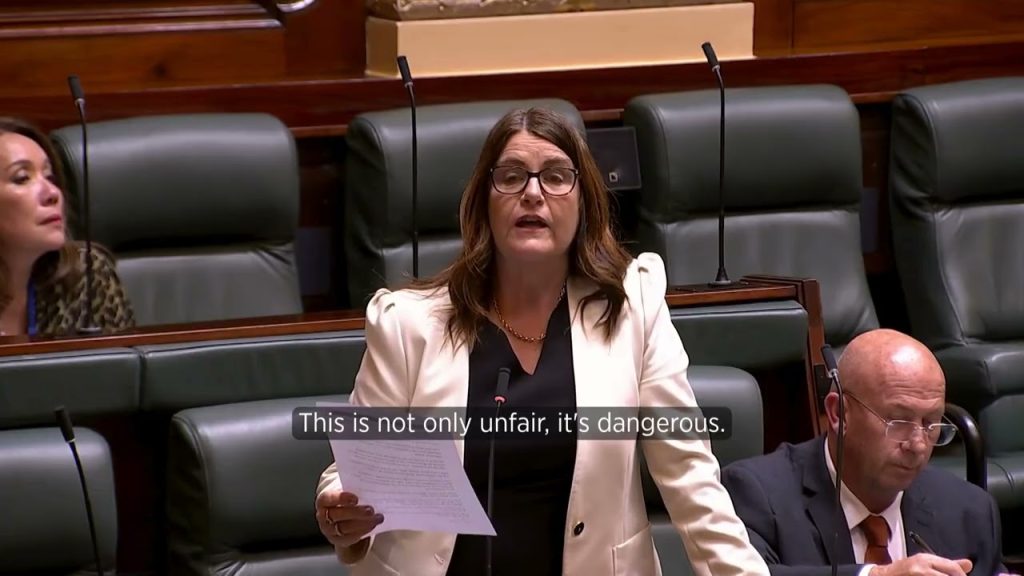
Ms Britnell said the Allan Labor Government have had decades to develop responsible decommissioning methods.
“Burying massive concrete blocks in productive farmland is not environmental management, it is environmental neglect,” she said.
“Concrete is recycled all over the world and reused in road construction. Choosing burial over recycling is not a technical limitation; it is a failure of responsibility.”
Ms Britnell emphasised that ultimate responsibility for environmental protection, particularly below the surface, where landholder responsibility ends, lies with the Victorian Government.
Allowing buried industrial waste beneath some of Victoria’s most productive farmland, she warned, would set a dangerous precedent.
Only 7% of the Earth’s land surface is arable, and that figure is shrinking. Ms Britnell said Victoria cannot afford to treat agricultural land as disposable.
“This is not how communities expect the environment to be managed in 2026. It’s unacceptable to simply bury the problem and walk away.”
The original turbines were around 80 metres tall, each requiring a 500-tonne concrete foundation. Turbines now reach 250 metres, meaning foundations are significantly larger, multiplying the scale of the problem if action is no taken now.
The wind company involved has stated it is researching options for recycling turbine blades and will not bury them. Ms Britnell argues that the same standard must apply to concrete foundations.
“If burying blades is unacceptable, then burying hundreds of tonnes of concrete is equally indefensible.”
Ms Britnell said the community is demanding accountability, transparency, and enforcement of permit conditions.
“We cannot allow an environmental legacy of buried industrial waste beneath Victoria’s most valuable farming land. Regional communities deserve better.”
